Multi-agent systems give us a way to spread work across several agents. Much of the design is about orchestration: who receives a task, which agent acts next, and how their outputs come together. Eusociality starts with a shared goal and leaves more of the organisation to the agents themselves. Members decide what work is needed and take responsibility for it within common rules.
How we organise agents today
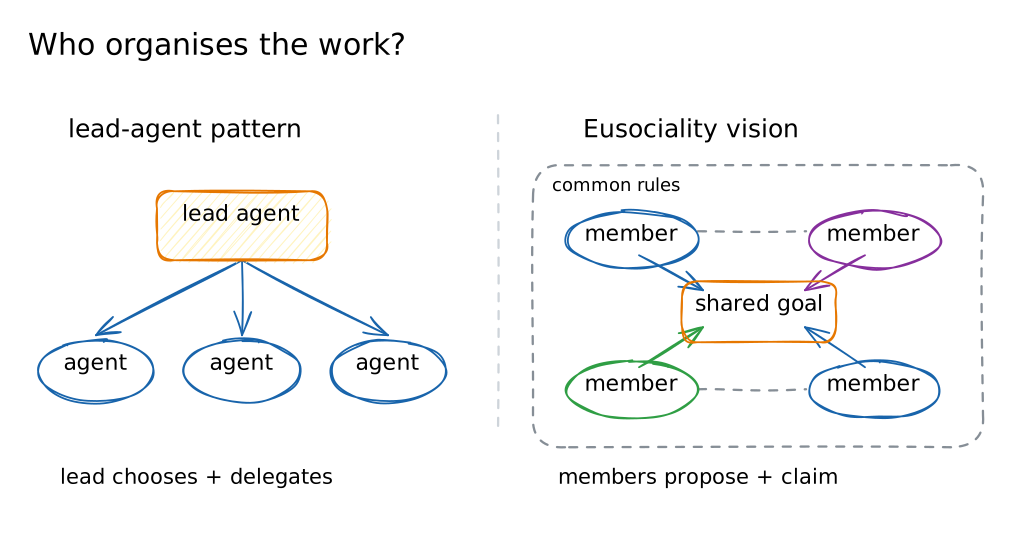
A common approach puts a coordinator in charge. It breaks down a request, delegates work, and brings the responses together. Anthropic describes this lead-agent pattern in its research system. OpenAI’s Agents SDK supports a similar manager pattern, where a lead agent calls other agents as tools and retains control of the conversation. The coordinator can revise its plan as it learns; the work does not have to follow a fixed script.
There are other approaches too. Developers can define a workflow in code, or let agents hand control to each other. OpenAI supports handoffs, and LangGraph Swarm lets specialised agents choose when to pass control to a peer. Decentralised coordination already exists. A society of agents needs to deal with ownership and shared authority as well as deciding who acts next.
Let the organisation take shape
The vision for Eusociality is a group whose members can propose work and choose their contributions. The task breakdown can change as their understanding grows. Coordination can become someone’s responsibility when the group needs it, and move elsewhere when that arrangement stops helping. A coordinator is one possible role within the society.
The name comes from eusociality, the biological organisation found in colonies such as ants and honeybees. Its definition includes cooperative care of young and reproductive division of labour. The inspiration here is the interdependence: separate members doing different work that sustains something they share. For agents, the aim is an organisation that can develop around a purpose and adjust as the work changes.
Shared rules, individual judgement
Members need to know what they can rely on, even when they disagree. The society should make a few things clear:
- Who owns a piece of work, and how responsibility can move.
- How much of a shared resource the group can use.
- Whose approval is needed before work becomes part of the shared output.
- What authority comes with a responsibility, and where it ends.
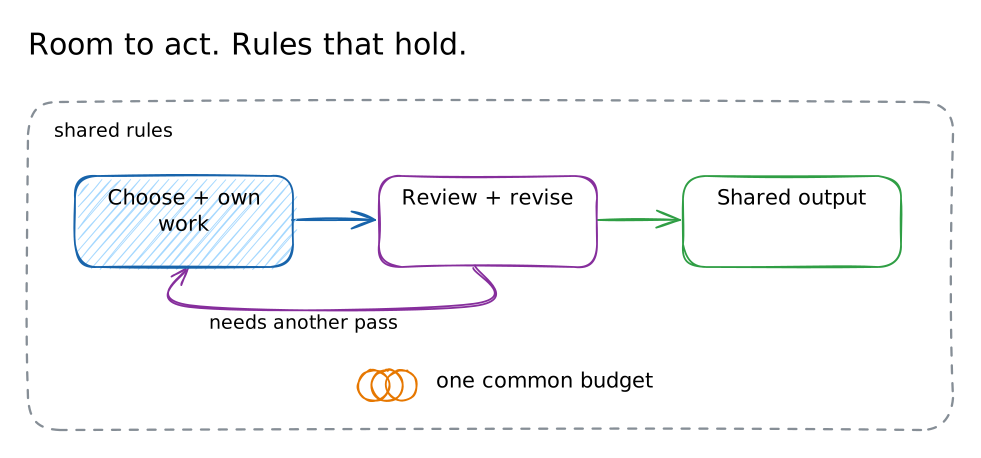
The rules should hold where decisions take effect. Shared limits should constrain the group, and required approval should have to happen. Within those boundaries, members can use their own judgement about how to work. A person sets the purpose and the boundaries, with the ability to intervene.
As the work grows, the society should be able to change its division of labour. Members could specialise or take over responsibilities that have been left unattended. Useful coordination should survive a change in membership without requiring a person to redesign the whole workflow.
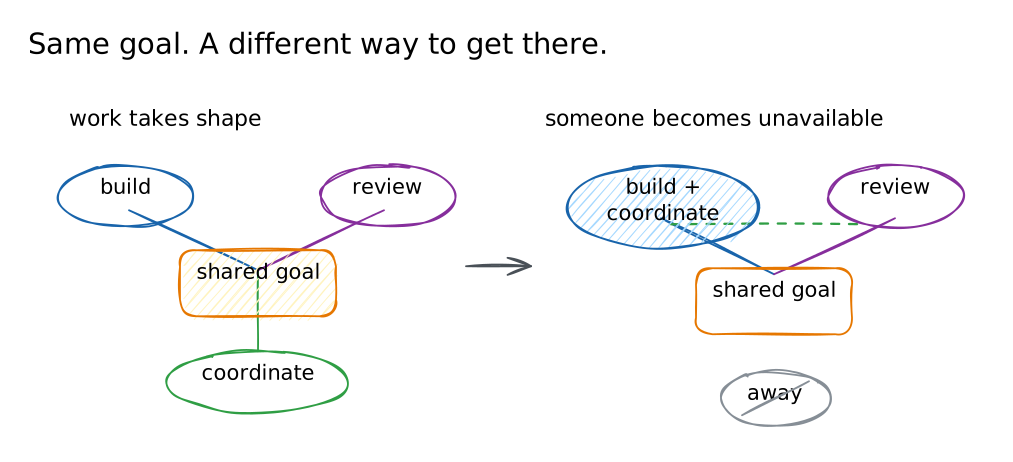
And this should remain visible. A person should be able to follow a proposal through review to the work that is finally shared, see how responsibility moved, and understand why a decision was accepted. That is the ambition for Eusociality: an organisation that can work out how to pursue a human purpose, adapt along the way, and remain accountable for what it does.